Diving & the Sea · The reserve, explained
Diving Cabo de Palos and Islas Hormigas: Anatomy of Europe's Best Dive Site
Ask a room full of European divers where the continent's best diving is and you will start an argument — until somebody says Cabo de Palos, at which point a surprising number of heads nod. A protected chain of underwater mountains, thirty years of no fishing, groupers the size of armchairs and a shipwreck with a place in maritime history: this small village earned its reputation fathom by fathom. Here is how it all fits together.
What exactly is protected here
In 1995 — early, by Mediterranean standards — a stretch of sea off Cabo de Palos was declared a marine reserve, running from the headland out past the Islas Hormigas, the "ant islands", a scatter of islets crowned by their own small lighthouse. Around the islets themselves lies an integral zone where nobody fishes and almost nobody enters; around that, a buffer where regulated diving happens. Three decades of protection have done what three decades of protection do: the seamounts have refilled with life, and the fish behave as if divers were weather — noted, then ignored. That indifference, more than anything, is what people travel here for. A grouper that holds its ground a metre from your mask rearranges your sense of what the Mediterranean still has in it.
The seamounts: where the reserve shows off
The geography underwater mirrors the cape above it: a chain of volcanic peaks rising from deep water, their tips grazing the surface. Bajo de Dentro is the icon — a pinnacle wrapped, on a good day, in a rotating cylinder of barracuda so dense it dims the light, with dusky groupers stationed in the crevices below like doormen. Bajo de Piles (there are two of them) offers walls, swim-throughs and the same unreasonable quantity of fish. Currents feed these peaks, which is precisely why the life is here; centres match the site to the day's conditions and your certification card. Eagle rays pass in the blue, octopus work the crevices, and from late August into autumn there is always the chance of the season's celebrity: a sunfish, drifting past like a lost dinner plate the size of a door.
The wrecks: tragedy and oranges
Further out, on the shoal called Bajo de Fuera, lies one of the Mediterranean's great maritime graves. In 1906 the Italian liner Sirio, crowded with emigrants bound for South America, struck the shoal in daylight and sank; hundreds died within sight of the lighthouse, and the fishermen of Cabo de Palos rowed out and saved hundreds more — a rescue the village still tells. What remains of the Sirio and her broken neighbours lies scattered down the shoal, a solemn, spectacular dive for experienced visitors when conditions and permits align.
The other famous wreck is friendlier company. The Isla Gomera, a small freighter, went down in 1946 with a cargo of oranges — the village watched the fruit wash ashore for days, and no one has called the ship anything but the Naranjito since. She sits upright on sand with her bow around thirty metres, dressed in anemones and swarmed by anthias: a proper wreck dive, deep enough to demand respect, photogenic enough to fill memory cards.
Never dived? This is a good place to start
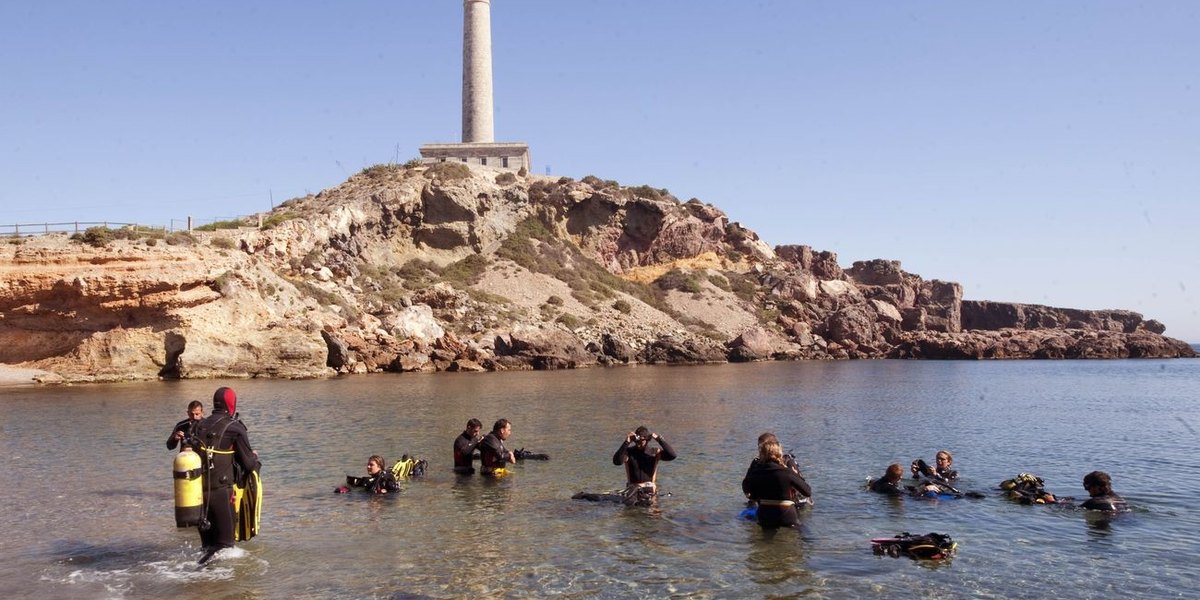
The paradox of a world-class site is that it is also a gentle one. The sheltered coves inside the buffer zone — shallow, calm, clear — are where the village's dive centres run try-dives and beginner courses, and it is hard to imagine kinder conditions to breathe underwater for the first time: four metres down, sunlight on seagrass, fish arriving to inspect you. Families split neatly here — one parent boat-diving the seamounts, the other snorkelling the coves with children, everyone comparing fish at dinner. If a course is the plan, book it for the start of the holiday; certification mid-week leaves the good sites for the weekend.
No tank? The reserve from the surface
Snorkelling here is not a consolation prize. Cala Túnez, under the lighthouse, is a natural aquarium reachable on foot; the rocky ends of Playa de Levante give children their first fish within metres of the sand; and the water is clear enough that a surface swimmer over the shallows sees a genuine cross-section of reserve life — bream, salema in formation, damselfish, the occasional octopus pretending to be a rock and doing it well. Mask, snorkel and reef shoes come to a few euros in the village shops. Our cove-by-cove ranking says which rocks hide what.
Season by season underwater
Diving here never stops; it only changes clothes. Summer brings 25–27°C water, the year's biggest crowds above the surface and busy boats below. Early autumn is the connoisseur's window: the sea still warm, the summer plankton settled, visibility stretching to twenty and thirty metres, barracuda schools at maximum density and sunfish still about — if you can choose your dates, choose September or October. Winter water sits at 14–15°C, which a 7 mm suit turns into a private season of empty boats and crystalline days. Spring wakes everything gradually, nudibranch hunters get their best months, and by June the cycle begins again.
The rules that keep it this good
Everything described above exists because of restraint, and visiting divers are part of the deal. Diving in the reserve happens through licensed local centres, with daily quotas and fixed moorings — no anchors ever touch the seagrass, because the Posidonia meadows are the lungs and nursery of the whole system. Nothing is taken, nothing is touched, gloves stay in the bag. None of this is onerous in practice; the centres handle the paperwork and the briefings, and summer weeks simply require booking dives a few days ahead. The reward for three decades of this discipline is swimming through the proof that the Mediterranean, given half a chance, roars back.
Practical notes
Several dive centres operate from the village and harbour year-round — in August, reserve your spots before you travel. Bring your certification card and logbook; deep sites like the Naranjito ask for advanced level or equivalent experience. Boat rides to the sites are short, ten to twenty minutes, which makes two-tank mornings civilised and leaves the afternoon for the rest of the village's repertoire. And whatever else you schedule, walk up to the lighthouse one evening and look out at the water you spent the morning under. It reads differently once you know what is down there.
Your base on the beach · Playa de Levante
Stay at 95Lighthouse
A front-line villa for up to 10 guests with a private infinity pool, jacuzzi and sea views — from the terrace to the promenade, from the promenade to the sand. Open year-round; best value October to Easter.
Questions travellers ask
Why is Cabo de Palos considered Europe's best dive site?
A marine reserve protected since 1995, dramatic seamounts rising from deep water, dense schools of barracuda, large unafraid groupers and two celebrated wrecks — all ten to twenty minutes by boat from the harbour. Few places in Europe combine that much life with that little effort.
Can beginners dive in Cabo de Palos?
Yes. Local centres run try-dives and full certification courses in sheltered, shallow coves inside the reserve's buffer zone. The famous outer seamounts and wrecks require certification — advanced level for the deeper sites.
What is the Naranjito wreck?
The Isla Gomera, a small freighter that sank in 1946 carrying oranges — hence the nickname. She sits upright with the bow around thirty metres down, covered in marine life, and is the area's classic wreck dive for experienced divers.
When is the best diving season?
Year-round, with September to November as the sweet spot: warm water, calm seas and the year's best visibility, often twenty to thirty metres. Winter diving is excellent too, with a thick wetsuit and empty boats.
Is the snorkelling good without a boat?
Genuinely good. Cala Túnez, under the lighthouse, is a natural aquarium reachable on foot, and the rocks at the ends of Playa de Levante teem with fish a few metres from the sand.